Researching The Royal Canadian Regiment

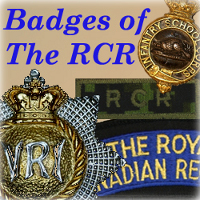
During the early years of the reign of His Majesty King George V, the official badge (in the eyes of the Militia Department) for The RCR was that ensigned with the King's cypher. The Regiment, however, continue to wear "VRI" badges and to pursue official permission to wear the cypher of Queen Victoria, which was granted in 1919.
August 1916
NOTES ON OFFENSIVE OPERATIONS.
1. The following Notes on semi-open fighting, which is at present being carried on by the Troops between the ANCRE and the SOMME, are forwarded for information and guidance of Commanding Officers with a view to the training and preparation of the 3rd Canadian Division.
2. In the area where the original German lines have been broken and our advance made, fighting is continuous. The normal trench warfare and strong lines of trenches have been replaced by improvised trenches and a constant changing of lines and positions. Everything is in a state of "flux".
3. On the average, neither side has more than two lines of trenches, more often than not these are not joined up. Consequently the initiative and powers of leadership of the platoon and company commander have become more than ever of great importance to ensure success in this type of warfare.
4. The "Set piece" type of assault carried out in many waves from our original trenches against the original German lines with our objectives fixed great distances in rear, is now not applicable in the "semi-open" fighting. The main object now of each attack is to gain and consolidate each German line in succession, that is to say a very limited objective. In place of the many waves an advance in two waves is now adopted (vide para. 10 below).
5. The "Artillery bombardment preceding these attacks requires, as before, the most careful arrangement. It must be so worked out that it is never twice the same and must not give the enemy any indication of when the actual Infantry assault is going to be launched, in short, the Artillery must ensure that the actual assault is a complete surprise.
6. The best form to be adopted is a series of intermittent bombardments extending over several days by heavy Artillery, field guns and field howitzers at odd times and of varying periods. The Heavy Artillery bombard on previous registrations and check up with air photos. The Field Guns and Howitzers put on various hurricane bombardments intense shrapnel barrages. Continuous firing is kept up day and night. F.O. Officers must be well forward and the liaison between Infantry and Artillery of the closest nature, Battalions being directly linked up to Batteries.
7. It has been found best to put but a small number of Infantry actually into the assault. The average frontage allotted to a Battalion for an assault is from 400 to 500 yards.
8. The average distance of the objective and length of an advance is 200 yards.
9. The detailed orders for this type of assault and the arrangements made by Divisions which have recently carried them out are being obtained and will be issued later.
10. The following are understood to be a general outline [of] the method adopted. The assault takes place at night, and:
(a) Immediately before the Artillery fire lifts the fire Infantry wave creeps up to within 50 yards of the barrage and closely follows it.
(b) The advance and assault is made in two waves -
(c) The first wave strength about 1/2 of force employed consists of riflemen, Lewis Gun Detachment and Bomb Squads. The riflemen and some bombers go only as far as the objective, seize and hold the trench and mop up. The Lewis Gunners and Bombing Squads move forward in small groups and their role is to push out in front of the objective and immediately establish themselves in any available cover as outposts groups to cover the objective. The skilful posting and handling of these groups is of the utmost value and will materially assist in the consolidation of the main objective. The must always be prepared to gain all ground possible whenever opportunity offers.
(d) The 2nd wave, strength about half the force employed is carrying and first consolidation party, it follows closely the first wave and its role is to do the first consolidation of the captured positions and assists the first wave in holding the objective. Very careful organization of these parties is required, every man should know exactly what are his duties.
(e) Supports and reserves move up to the line from which the assault was launched according to the tactical situation.
(f) Special carrying, working and consolidating parties of Infantry with Pioneers and Engineers will be organized under Divisional arrangements and be ready to go forward as soon as circumstances, such as barrages, admit, and set out definite tasks. These will include, consolidation and linking up of the outpost groups laterally and to the captured line, construction of dugouts and improvement of captured line, making communications back across "no man's lend" to our old line. These parties will not accompany the assault.
11. Machine Guns of Machine Gun Companies will be employed covering our front continuously throughout the Operation's barrages, this must be practised by Machine Gun Companies.
12. The Field Artillery will cover the consolidation with intense shrapnel barrages.
13. Stokes Guns will cover the original assault and will usually be brought forward later to the position after it has been consolidated.
Ammunition can be carried forward in baskets and improvised carriers (a type is being obtained and will be issued.
Bombers and mopping up parties will be provided with "P" Smoke Grenades with rod attachment for firing from the rifle. Each Rifleman will carry two bombs in the haversack, these will be most sparingly used.
Spare bombs are best carried up in buckets or empty packs used for this purpose.
14. Details of equipment and ammunition to be carried by the man in fighting kit will be issued later.
15. Every means of communication must be adopted - Telephones, visual with lamps and f1appers, pigeons and runners. Visual and runners have been found to work well. Telephones cannot be relied upon. Infantry Signallers will be given every possible opportunity of practising visual signalling. Communication to contact aeroplanes is best maintained by flares.
16. Patrolling must be continuously carried out with great boldness both by day and night.
17. Liaison is of paramount importance. In this type of confused fighting Battalions must keep in touch and know where their Companies are, and of Units on their flanks, Brigades will keep up liaison with Battalions, Divisions with Brigades. This applies also to Units to a flank. Unless the situation is constantly reported and position of Units both in front and flanks is known to Commanders of formations, Artillery cannot cooperate and operations will not be successful.
18. Particular attention is directed to S.S.119, "Preliminary Notes on the tactical lessons of the recent Operations" issued by General Staff G.H.Q.
Lt-Colonel,
General Staff,
3rd Canadian Division.
13-9-16.